

The renowned Lithuanian children’s writer and illustrator Kęstutis Kasparavičius spent years telling stories without many words. He drew them. In his illustrations, objects acquire personalities, animals take on human weaknesses, and completely ordinary things around the house seem simply to be waiting for the right moment to come alive. Writing came much later – almost by accident, from one story that was supposed to accompany an illustration and from an answer given to a Taiwanese publisher before he had time to think carefully about what he had said.
That was how Kasparavičius, who for a long time considered himself primarily an illustrator, also became a writer.
In an interview for “Zmaj”, the renowned Lithuanian writer and illustrator Kęstutis Kasparavičius talks about his first drawings for school textbooks, the unusual way his first book came into being, stories that first appear to him as images, Pinocchio who, he believes, never entirely disappears from a person, humour without which life is much harder, and books which, once they leave his desk, begin travelling around the world without him.
And there is another lovely coincidence: Kasparavičius and “Zmaj” were born in the same year – 1954.

His story with books, however, began neither with dragons, nor unusual animals, nor picture books. It began much more modestly – with agricultural tools, plants, insects and weeds.
– For many years I worked as an ordinary book illustrator. I became a writer very late, when I was almost 50. So, naturally, my first published works were drawings.
The first pages he illustrated were far removed from the world for which children around the globe know him today. He came to them thanks to a family friend who needed help finishing a job under an almost impossible deadline.
– My first attempts at illustrating books led me to a Lithuanian publishing house in Kaunas that specialised in publishing school textbooks. Once, a family friend asked me whether I would agree to take over her commission and illustrate several school textbooks. The deadlines were “burning”, and she herself would never have had enough time to finish it on time. Since the publishing house did not object, I accepted the offer with great pleasure.
Instead of imaginary heroes, he then found himself facing objects and scenes from an entirely different world.

– They were two textbooks called “Agricultural Work” for fifth- and sixth-grade pupils. It was not very difficult for me to draw the illustrations because I had already made similar technical drawings while studying industrial design at the Vilnius Academy of Arts. I drew agricultural tools, various plants, insects, pests, weeds and other similar things.
He may not have been particularly satisfied with the result himself, but one extensive job completed on time was enough to set something much bigger in motion.
– The fact that I managed to finish this rather extensive job on time probably impressed the publishing house. Although the final result was not particularly impressive to me, it was my beginning. Not long afterwards, I received another offer from the same publishing house: to illustrate a real picture book – Kasparavičius recalls.
For years afterwards, it never even occurred to him that, in addition to illustrations, he might also put his name to stories. He had a very clearly defined place for himself: he was an illustrator. Writing belonged to someone else.
Until an invitation arrived from Taiwan that changed that.
– To be honest, I never planned to become a writer because I was sure I had no talent for it.
The invitation came from the publishing house “Grimm Press”, with which he had already been collaborating. They were preparing a charity book and asked illustrators from different countries to write one short, humorous story to accompany a drawing.
– It happened completely unexpectedly, when I received an unexpected offer from the Taiwanese publisher “Grimm Press”. I had already been working with this publishing house for some time and had illustrated several children’s classics. In 2002, “Grimm Press” was preparing to publish a book for charitable purposes, for children affected by the terrible earthquake that had happened that same year.
That was how “The Songman” came into being – a small story that was supposed to be merely an addition to one illustration.

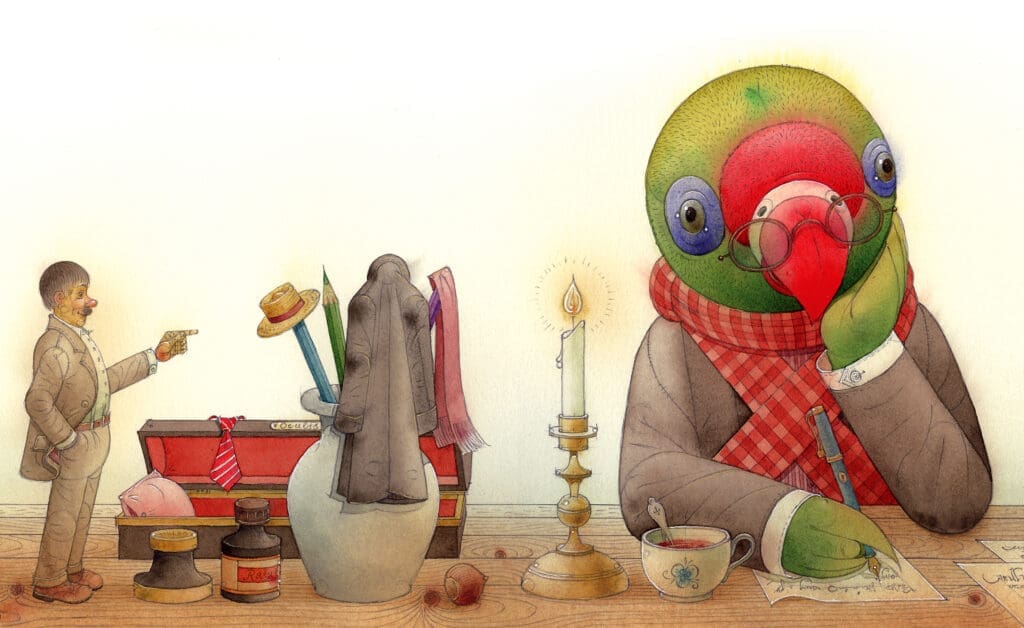
– Illustrators from all over the world were invited to draw one illustration for the upcoming book and to devise a short, funny story to accompany it. But, of course, not about the earthquake. That was how I created my first story, entitled “The Songman”. It was a story about a tiny man who was caught in a cage by strange green birds resembling penguins. That was how my first story came into being.
And then came one very simple question: did he have any more stories like that?
Kasparavičius answered – yes.
– A little later, the publisher K. T. H. asked me whether, by any chance, I had any more stories like this. Not quite understanding why he was asking me that, I answered: yes, I do!
No sooner had the answer been sent than it became clear that he would somehow have to live up to those few words.
– In fact, I had nothing except that one short story about the chirping man. The following week I received another letter from “Grimm Press”. They wrote that it would be wonderful to publish a larger collection of my short stories, and the new book required a total of 36 stories. That was how I got caught.
Instead of backing away, he chose the adventure. After all, as he thought at the time, Taiwan was far enough away that perhaps nobody would even notice a possible literary failure.
– Of course, all of it seemed like an irresponsible adventure, but on the other hand, it was very difficult not to try. I simply thought that Taiwan was far away and, if the worst came to the worst, nobody would ever find out about my literary failure.
He asked for only a little time – supposedly to translate the already written stories into English. In reality, he first had to write them.
– So I asked K. T. H. to give me some time to translate the stories, which in fact had not even been written yet, into English, and I got down to work. Writing itself was not easy for me, but at that time there was no shortage of ideas. The stories were written in a month, and it was the fastest book I have ever written.
From one story came a book, and from an illustrator who had not intended to write – a writer.
– That was how my first book, “Silly Stories”, came into being, and it was first published in Chinese. The following year another book of short stories followed. Only much later were all those stories, divided into three parts with different titles, published in Lithuanian and other languages.
Even today, however, Kasparavičius does not easily separate words from images. In his work, they have belonged to one another from the very beginning.
– Still, I would not call my first short stories real literature. They came to me first and foremost as images, which I drew while adding short explanatory texts. So it could be said that they were books of illustrations with comments – the Lithuanian writer and illustrator says candidly.
First He Sees the Story, Then He Writes It Down
Some writers first hear a sentence. With Kasparavičius, an image appears first – almost like a frame from a film. Only after that come notes, sentences and pages.
– I consider myself more of an illustrator than a writer. All the stories first appear in my mind as images, like film frames. I immediately write down short notes about them. Very short, just so I do not forget.
The image and the text then grow together, changing one another until the book takes its final form.
– Then I gradually begin to draw and put together small sketches, returning to the text at the same time. So both the text and the rough sketches appear almost simultaneously. After finishing the sketches, I refine the text, because if you want to begin drawing the original illustrations, you need to know exactly which part of the text will be on each double-page spread.
Only when everything is in its place does the longest part of the work begin.
– The final stage is drawing the original illustrations. And this part always takes up most of the time I spend creating a book.
Some stories, however, know how to wait for a long time. His ideas do not disappear simply because they are not used immediately. They remain stored away, sometimes for years, until their moment comes.
– It is difficult to say when the original idea for a new book appears, because a great deal of time passes from the moment it comes into your mind until the moment it is finally realised. I write down all my new ideas and put them into one folder on my computer. Quite a lot of such unfinished stories are there at the same time.
Some wake up after five years. Others never do.
– Some remain asleep for five or even more years before their development begins. Others, hopelessly flawed, eventually end up being deleted – and that is a fate I do not regret.
And when the time comes for watercolour, the part of the work he loves most begins.
– I especially enjoy the final stage of the illustration process. For me, it is always the part that gives the greatest pleasure. When everything has been carefully drawn on watercolour paper and all that remains is to colour the illustrations with watercolours.
Toward the very end of the book, he says, the brushes, colours and his hand seem no longer to need to negotiate with one another.
– I particularly enjoy drawing the last few illustrations. My hands, brushes and colours seem to suit me perfectly. And it feels as though you could draw anything in this world and keep drawing endlessly.
That is precisely why the ending brings more than relief.
– Unfortunately, the day comes when you suddenly realise that the illustrations are finished. That makes it even a little sad and disappointing. But some time passes, and eventually one day I find myself looking through that folder of unfinished stories again – the author explains.
Stories Hidden Among Ordinary Things
For Kasparavičius, imagination does not necessarily begin in some distant, imaginary kingdom. It is enough to look around.
A chair, an old object inherited from a grandmother, something we touch every day and almost no longer notice – all of it can become the beginning of a story.
– We all live surrounded by objects and things that we usually choose and buy ourselves. Some things have come to us as an inheritance from our parents or even our grandparents. These smaller or larger objects inhabit our homes for a long time. They become familiar and often unnoticed until they break.
The longer they remain with us, the less they remain merely objects.

– When you live with the same things for a long time, they become part of your life. I love my home and the things in it. Sometimes, looking at them, I feel as though they are looking back at me, returning my gaze, coming alive to tell me their stories.
Perhaps precisely in that ability to stop in front of something completely ordinary and look at it once again lies one of the keys to his world.
– There are so many little stories flying around us. You simply need to look at them more carefully, listen very carefully and catch them.
That is why there are not many things in his home, but those that are there usually have a past of their own.
– Many people often have too many things. My home contains only those that are necessary. Mostly very old things with a rich history. Of course, there are also some new things, primarily connected with modern technologies. It would be very difficult to get rid of them today – says the renowned Lithuanian writer and illustrator.
The Pinocchio That Remains Within Us
Among all the books he found as a child in his parents’ large library, one never completely left him.
Pinocchio.
– I read many very different books in my childhood. As many as I could find in my parents’ large library. But one of those books is special. It is “Pinocchio” by Carlo Collodi. The book about Pinocchio has been with me throughout my life.
He illustrated Collodi’s book twice, in two different periods of his creative work.

– Among other things, it is the only book I have illustrated twice. The first time, in 1993, it was published by my German publisher “Coppenrath Verlag” from Münster. And the second time I illustrated “Pinocchio” – I drew new monochrome illustrations – for the publishing house “Tyto Alba” from Vilnius, in 2002.

But what kept him close to this book was not only its hero, but what he sees in the hero’s journey.
– It is a story about the winding path full of mistakes that everyone follows while changing from a child into a responsible adult. And that path does not actually stop at the end of childhood, but lasts much longer. Mostly until the end of your life.
Pinocchio, he believes, does not remain only between the covers of the book.
– There is probably a little part of Pinocchio in each of us. Sometimes hidden very deeply, and sometimes visible to the naked eye. Very often, when thinking about my own behaviour, I have to admit to myself that this little Pinocchio inside me has not disappeared.
It is through Pinocchio that he also comes to Federico Fellini, who saw much more in the wooden hero than a character from a children’s book.
– Pinocchio was the favourite character of the famous Italian director Federico Fellini. Sometimes his friends simply called him Pinocchio, and Fellini himself often mentioned him in his interviews. He considered “Pinocchio” one of the best books in the history of literature.
Kasparavičius feels particularly close to Fellini’s thought about the end of the story, the moment in which the mischievous puppet becomes an obedient boy.
– Carlo Collodi lived in the nineteenth century and therefore simply had to end the story of Pinocchio in a moralising way: by turning the disobedient puppet into an obedient boy. According to Fellini, however, that is the least interesting and even the saddest part of the book.
Because growing up, however inevitable, always takes something away with it.
– And indeed, as the years go by, we lose the magic of childhood and Pinocchio as a part of our personality. At the same time, we also lose our connection with life as it ought to be. And with that loss we become good pupils, good spouses, good citizens and even good sleepers – observes the Lithuanian writer and illustrator.
A Book Does Not Have to Teach a Child a Lesson
Kasparavičius does not draw a sharp line between a book for a child and a good book in general. He likes it even less when a story persistently tries to teach its young reader something.
– Yes, I am completely certain that a good children’s book should be a good book in the general sense. Sometimes I say that I do not create books for children, but for myself – or, more precisely, for that inner child that has remained there since my childhood.
He still remembers very well how, as a child, he reacted when adults tried to explain to him what he should think or do.
– I really dislike moralising and didacticism. I remember that when I was a child, if someone very persistently told me to do this or that, I usually wanted to do the opposite.
That is why his books do not give the reader a ready-made answer.
– If anyone ever finds any message in my books, it is hidden so deeply that it seems as though I did not send it, but that the reader discovers it themselves.
The same book, after all, is never quite the same in the hands of two readers.
– When you read an interesting and appealing book, you dive into an imaginary world. And that world is different for everyone, even though we are all reading the same book.
Perhaps one of the most beautiful parts of reading begins precisely there – where what the writer intended comes to an end.
– After all, we all wake up in the morning in a different reality, despite the fact that we live in the same city, on the same street or even in the same house. There is probably no writer who knows how their books will be read. But that is where all the fun lies – adds the Lithuanian writer and illustrator with a smile.
Humour Preserves Something Important
In the world of Kasparavičius’s books, humour is not an ornament added to a story to make it more cheerful. It is a way of looking at life.
– Yes, that is true. Humour plays a really important role in my books. From the first books I illustrated all the way to the most recent ones for which I wrote the texts myself.
The world, he says, is not perfect, nor is life always easy.
– Life can sometimes be far from easy. And our world is not an entirely perfect place to live. But we have no other place. And even if we found one, who could say with certainty that this other place would be better?
Humour therefore helps leave room for lightness in everyday life.
– That is why we must do our best and find a way to make our stay here meaningful. I think a healthy dose of humour can really help us cope with that.
Even in serious things, there is sometimes a small crack through which a smile can pass.
– Very serious and even sad things often have their comical side. Humour can give us hope and the ability to enjoy all the little things of everyday life – Kęstutis emphasises.
Behind the Animals, We Often Find Ourselves
His books are inhabited by animals, objects and unusual creatures, but when we look at them more closely, we can easily recognise ourselves in their actions.
– My stories about things and animals are at the same time stories about people. Perhaps even more about people.

Kasparavičius lends them our habits, weaknesses and characteristics, while leaving them what makes them animals or objects.
– When I create my characters, I give them human characteristics while at the same time retaining the characteristics of things or animals. This combination of different qualities and weaknesses of people and things can be very unexpected and appealing.
Sometimes the result surprises even the author himself.
– For me, it is a kind of game. Often, while drawing illustrations, I unconsciously stop and smile or even begin to laugh at my characters. If someone were watching me from the side at that moment, it would probably look a little strange – admits Kasparavičius, the Lithuanian writer and illustrator.
What a Word Cannot Do, an Image Sometimes Can
When the same person both writes and illustrates a book, the text and the image do not have to retell the same thing to each other.
– Drawing and writing, although they have something in common, are very different things. You cannot draw everything that happens or everything you feel. Just as not everything you see with your eyes can be written down.
For Kasparavičius, the advantage lies precisely in that difference.
– When you are both the author and the illustrator, you have a great opportunity to choose: where you will tell the story through text, and where it is better to tell it through an illustration.
When one side has already said enough, the other can remain silent.
– It is not necessary to draw everything that has already been written or to write everything that has already been drawn.
And because creating an illustration takes a long time, the story can still change during that time.
– Drawing illustrations is quite a long process, and you can always correct some parts of the text if you think it is necessary. The important thing is simply not to ruin the layout you already created at the beginning – Kasparavičius advises.
The Golden Pen from Belgrade
Among the cities and countries through which the work of this Lithuanian writer and illustrator has travelled, Belgrade holds a special place. Here, in 1990, he received the Golden Pen – his first international award.
Kasparavičius now speaks about awards without much ceremony.
– To be honest, awards are not very important to me. They are like a small piece of candy that you unwrap, eat, enjoy and immediately forget about. Yes, it is delicious, but it lasts only a very short moment.
But at the beginning of an artistic journey, such a “piece of candy” can still mean a great deal.
– Perhaps it is more important when you are young and just beginning your creative career, because it gives you confidence and confirmation that you have not made a mistake in choosing your path. But later it is no longer very important.
He remembers the Golden Pen precisely because it came at the right moment.
– The Golden Pen award really was important to me because it was my first international award.
After that, his work found its way more easily to new exhibitions and publishers.
– After that, it became much easier for me to achieve success at the illustrators’ exhibitions of the Bologna Children’s Book Fair and to establish contacts with foreign publishers. Especially with my German and Taiwanese publishers, with whom I collaborated for many years – he recalls.
When a Book Sets Off into the World on Its Own
A writer and illustrator live with one book for months or years. And then they hand it over to the publisher – and suddenly it is no longer only theirs.
– When you finish a new picture book, hand it over to the publisher and it is printed, you simply forget about it. Usually you begin some new project, while that book itself begins to live its own life independently of you.
Sometimes that life takes the book very far away.
– If you are lucky, the book is translated into other languages and begins a journey around the world.
Even today, Kasparavičius finds it a little strange to imagine that somewhere, in a country he may never visit, a child opens his book and reads it in their own language.
– It is truly amazing, and even a little strange, to think that perhaps right now somewhere on the other side of the world, in places I will probably never visit, some child is reading my book in their own language.
His books have so far spoken in as many as 24 languages.

– The books I have written and illustrated have already been translated into 24 languages.
And the journey is not over yet.
– About a month ago, my agent informed me that he had sold the rights to one of my books to an Indian publisher, which will publish it in Assamese. Could I ever have believed that?
Serbian is now among those languages as well.
– And, of course, I am very happy that my books are also being published in Serbian. It is also interesting that most of my books have already been published in the Adriatic region: in Croatian and Slovenian. And now this is a good beginning in Serbian as well – says the Lithuanian writer and illustrator.
“Zmaj” and Kęstutis – Together Since 1954
And then, during the conversation, we came to an unusual fact.
Both “Zmaj” and the Lithuanian writer and illustrator Kęstutis Kasparavičius were born in 1954.
One has been travelling among readers for more than seven decades, while the other has drawn countless worlds during those decades. So we asked him what a dragon that could travel through time might be like.
– It seems that this Zmaj and I are the same age. After all, I was born in that same year, 1954.
Dragons have already appeared in his drawings over the course of his life, although, as he says, he does not remember many of them.
– It is difficult for me to remember everything I have drawn in my life. But I remember only a few dragons. One that sleepily placed its egg in a chicken coop just before Easter, and another that accompanied a duck and a kangaroo travelling around the world.
And perhaps one new dragon is still waiting to be drawn.
– The story of a dragon that travels through time is a very interesting idea, and I will definitely think about it – promises the Lithuanian children’s writer and illustrator.
Don’t Wait Until You’re Fifty
At the end of our conversation, we asked him what he would say to a young “Zmaj” reader who may already have a story, a poem or a character of their own, but has not yet gathered the courage to put them on paper.
The answer could fit into a single sentence.
– First of all, if you want to create something – a story, a poem or even a book – do not wait until you turn 50, as I did. Just do it right away – Kęstutis Kasparavičius says at the end of the conversation.


